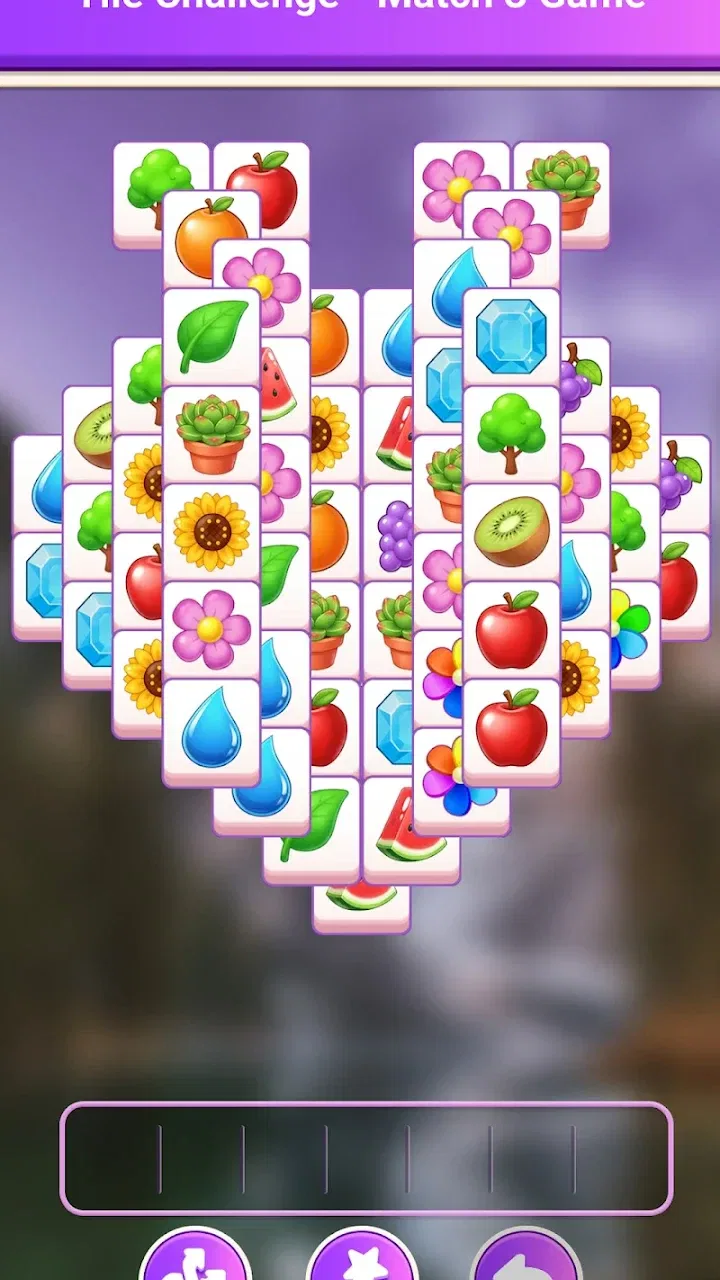
Tile Challenge - Match 3 Game
- 4.6
- Rating
- 1.00M
- Installs
- Free
- Price

 Analysis by App-foxy
I approached Tile Challenge as the kind of casual puzzle game you open when you have a few spare minutes but still want something that rewards attention. Its basic appeal is easy to understand: match tiles, collect progress, and work through daily challenges. What matters in practice is whether that simple loop stays satisfying after the first few sessions, whether it fits short breaks, and whether its limitations become annoying. After spending time with it, I see a focused puzzle experience rather than a broad all-purpose game.
The game is free, belongs to the casual category, and comes from Hi software 1984. It has reached over a million installs and holds a 4.6 average from around two thousand ratings, which suggests that its straightforward format has found a sizable audience. It is marked for Teen players, runs on Android 8.0 and later, and the current version is 2.3.0. Those details make it accessible to many Android users, although the age label is still worth checking if you are choosing a game for a younger player.
How I Decided Whether It Was Worth Keeping
I judged whether this game deserved a place on my phone by looking beyond the first burst of curiosity. The useful test is whether its tile decisions still feel worthwhile once the routine is familiar, and whether the daily prompt supports your day rather than claiming space in it. That gives me a practical way to weigh its lasting value against the attention any recurring game asks for.
You May Also Like

 Blood Strike: 2.5 Anniversary
Blood Strike’s Loadouts Turn Every Drop Into a Tactical Gamble
A close look at Blood Strike’s custom loadouts: how fast access to signature weapons reshapes its battle royale rhythm, rewards preparation, and narrows the gap between fights.

 Pandora - Music & Podcasts
Pandora’s Music Is Easy to Start, but Harder to Recover
Pandora’s strength is its low-effort path from a seed to a station. Its weak spot is how much confidence it asks you to place in connection, setup, and quiet recovery.

 8 Ball Pool
 Is Built on Rivalries, Rematches, and Routine
A close look at the rivalries, rematches, shared routines, and unanswered safety questions that turn a quick pool match into a persistent mobile community.

 Samsung Music
’s Quiet Strength Is Playing What You Already Own
Its reach comes less from spectacle than from dependable access to a personal library. That simplicity is both the app’s strongest retention engine and its ceiling.

 AccuWeather: Weather Radar
AccuWeather Review: A Quick, Clear Forecast for Everyday Decisions
For everyday plans, the best forecast is the one you can understand quickly. AccuWeather makes rain timing, radar, and local conditions easy to act on, with a few trade-offs.

 Hill Climb Racing
Why Hill Climb Racing Still Turns Crashes Into One More Run
A tiny car, a bumpy hill and one more upgrade: Hill Climb Racing keeps resurfacing because its simple chaos makes every near-miss feel personal.
More From Our News Desk
View All News


The real test is the moment-to-moment puzzle loop
For me, the first decision point was not the number of levels or the presentation. It was whether matching tiles felt readable and deliberate. A tile game can become tiring quickly when the board is visually noisy or when success depends more on guessing than planning. Here, the attraction comes from the small decisions: which match to make first, what space to preserve, and whether collecting an obvious pair now will make the next move harder.
That makes it a better fit for players who enjoy light planning than for people who want a completely automatic time-killer. You can play casually, but paying attention improves the experience. I found myself switching between quick matches and slower turns depending on how much time I had. That flexibility is useful during a short wait, though it also means the game may feel less relaxing if you prefer puzzles with no pressure to think ahead.
Daily challenges change the reason to return
The daily challenge structure gives the game a clearer routine than a simple collection of disconnected boards. Instead of opening it only when bored, I could treat the daily task as a small personal target. That is a modest design choice, but it helps the game feel more purposeful without turning it into a long commitment.
My advice is to use the daily challenge as a checkpoint rather than as an obligation. If you approach it as something you must complete every day, a casual puzzle can start to feel like another notification demanding attention. If you use it as a compact mental exercise, it works better. This is one of the less obvious strengths of the format: the daily element is most enjoyable when it adds structure without becoming the entire reason to play.
Collection gives short sessions a sense of progress
The collecting aspect matters because matching alone can feel repetitive. Even when a session is brief, collecting gives me a reason to finish one more attempt. It is not a substitute for deep progression, but it does make small bursts feel less disposable. I especially liked this during ordinary gaps in the day, such as waiting for an appointment or taking a short break between tasks.
A useful habit is to separate “practice” sessions from “progress” sessions. When I have only a minute or two, I can focus on making sensible matches without worrying about completing everything. When I have more time, I can play with a clearer goal and pay attention to the collecting side. That simple distinction prevents the game from feeling like every session has to deliver a major result.
It works best when your phone is already your puzzle device
Tile Challenge is designed around the convenience of a mobile screen. I would choose it over a larger, more demanding game when I want something immediately understandable and easy to pause mentally between other activities. The casual category is an accurate description: it does not ask me to learn a complicated world, manage a large team, or remember a long story.
That simplicity is also the main decision trade-off. Players who want narrative, character development, competitive depth, or a large variety of mechanics may find the experience narrow. The game knows what it is trying to do, but it does not appear designed to replace every other kind of mobile entertainment.
Where the game wins against familiar puzzle alternatives
Compared with match-three games built around dramatic effects, characters, and extended progression systems, this tile-focused approach feels more direct. I can concentrate on the board instead of tracking a larger fictional setting. That is valuable when I want the puzzle itself to occupy most of my attention.
It also has a different rhythm from endless casual games that offer an uninterrupted stream of nearly identical actions. The daily challenge gives me a natural stopping point, while the collection layer gives a small reason to continue. For someone who wants a compact routine rather than a huge content-heavy game, that balance is a genuine advantage.
Against traditional standalone puzzle apps, the daily structure makes it feel more current and repeatable. A purely static puzzle collection may be better for someone who wants to work through content at their own pace, but this game is more appealing if a recurring challenge helps you return. The choice depends less on which format is objectively better and more on whether you prefer a daily prompt or a fixed library.
Three practical habits that improve the experience
I avoid making the first obvious match automatically. I scan the available tiles for a moment and look for a move that keeps more options open. This is especially helpful when several pairs are available and one careless choice can reduce the useful space around the remaining tiles.
I use the daily challenge when I am alert, not when I am already distracted. A short puzzle can be a good reset, but it is less satisfying when I am rushing through it while doing something else. Saving it for a genuine break makes the challenge feel like play instead of another task.
I treat collection progress as a bonus rather than a reason to force a poor move. The temptation to chase a visible reward can make me ignore the board. In my experience, preserving a workable position usually creates a better session than grabbing the quickest possible item.
Where another type of game may fit better
There are clear situations in which I would recommend a different option. If you want a calm, almost meditative puzzle with no recurring challenge structure, a slower logic game may suit you more. If you want constant novelty, a match-three adventure with varied objectives may provide more variety. If you want competition with other players, a dedicated competitive puzzle title is likely a stronger choice than this focused casual format.
I would also hesitate to recommend it to someone who dislikes repetition. Matching tiles and collecting progress can be pleasant, but the core action remains familiar. The daily challenge changes the immediate goal rather than transforming the entire game. That distinction matters: this is a game for refining a simple loop, not for discovering a new system every few minutes.
What switching from another puzzle game really involves
The cost of switching is low in terms of learning. Someone coming from another tile or match game should understand the basic idea quickly. The bigger adjustment is psychological: you may need to accept a more concentrated experience instead of expecting a long campaign, a large cast of characters, or a constant stream of new mechanics.
If you currently play a heavily decorated match-three game, you may miss the sense of spectacle at first. On the other hand, moving from a very demanding puzzle game may feel refreshing because the entry barrier is lower. I would not replace a favorite game immediately. I would install this one alongside it and use it for short sessions; after several days, it becomes easier to tell whether its focused rhythm fills a gap or simply duplicates what you already play.
Because the game is free, trying that side-by-side approach is practical. The important cost is not money but attention. A daily challenge can become part of your routine, so I would decide in advance whether you want a small daily habit or merely an occasional puzzle. That choice will affect your satisfaction more than the initial download.
Device fit and age considerations
The minimum requirement of Android 8.0 or later makes the game suitable for many still-used Android phones, including devices that are not recent flagship models. I would still judge the experience by the screen and touch response of your particular phone, because tile puzzles depend on clear visual separation and accurate taps. A cramped or damaged display can make a simple board feel unnecessarily frustrating.
The Teen content rating is another practical point for families. I would not assume that a casual appearance automatically makes a game suitable for every child. Parents should check the rating in the relevant app store and decide whether the game matches the player’s age and their own expectations. For teenagers and adults who want a light puzzle break, the rating is less likely to be a deciding issue.
My recommendation for different kinds of players
I recommend Tile Challenge to people who want a free, easy-to-understand tile puzzle with a daily reason to return. It is particularly suitable if your ideal session lasts only a few minutes, you enjoy making small tactical choices, and you like collecting progress without committing to a large adventure. The game’s strongest quality is its focus: it gets to the puzzle quickly and gives short play sessions a clear shape.
I would skip it if you need a rich story, a wide range of game modes, or a constantly changing set of mechanics. I would also choose another puzzle game if you find recurring daily goals stressful or if you prefer to complete a large fixed collection entirely on your own schedule. The game is not weak because it lacks those things; it is simply aimed at a narrower kind of player.
For an everyday example, I can see using it during a commute break or while waiting for a friend. I would open it, attempt the daily challenge, and stop after a satisfying run instead of feeling pushed into a long session. That is the use case where it makes the most sense: a small, repeatable puzzle ritual that fits around real life.
Hi software 1984 has kept the current release at version 2.3.0, and the game’s established audience gives it enough presence to be worth trying rather than dismissing as an unknown experiment. Still, popularity does not remove the central question: do you enjoy the core matching loop? If the answer is yes, the daily challenges and collecting give that loop useful structure. If the answer is no, extra progress will not change the basic feel.
My final view is positive but specific. This is a good choice for focused, short-form tile puzzling, not a universal replacement for every casual game. I would recommend installing it when you want something free, approachable, and easy to fit into spare moments. Give it a few daily sessions, pay attention to whether planning improves your enjoyment, and compare that feeling with the kind of puzzle you already play. If the simple board decisions remain satisfying after the novelty fades, Tile Challenge deserves a place in your regular rotation.
FAQs for Tile Challenge - Match 3 Game
01What is Tile Challenge - Match 3 Game?
Tile Challenge - Match 3 Game is a puzzle app where players must match three or more tiles of the same type to clear them from the board. The game offers various levels of difficulty, intriguing challenges, and a vibrant design that makes it appealing for all ages. It's available on both Android and iOS.
02Is Tile Challenge - Match 3 Game free to play?
Yes, Tile Challenge - Match 3 Game is free to download and play. However, it does offer in-app purchases that can enhance the gaming experience. These might include additional lives, special power-ups, or ad-free gameplay. Players can choose whether to make these purchases or enjoy the free version.
03What are the main features of Tile Challenge - Match 3 Game?
Tile Challenge - Match 3 Game features hundreds of levels with increasing difficulty, daily challenges, and special events. It also includes colorful graphics and smooth animations. The game offers a rewarding system with bonuses and power-ups to help clear challenging levels, making it engaging for players of all skill levels.
04Are there any ads in Tile Challenge - Match 3 Game?
Yes, the free version of Tile Challenge - Match 3 Game does contain ads. These ads help support the development of the game. However, players have the option to remove ads through in-app purchases, providing an uninterrupted gaming experience for those who prefer it.
05Can I play Tile Challenge - Match 3 Game offline?
Tile Challenge - Match 3 Game can be played offline, allowing players to enjoy the game without an internet connection. This makes it a great option for playing on the go, whether you're commuting or traveling. However, certain features, such as daily challenges or updates, may require an internet connection.
Pros
- Engaging and addictive gameplay.
- Simple controls
- easy to learn.
- Colorful and vibrant graphics.
- Regular updates with new levels.
- No internet required to play.
Cons
- Ads can be quite intrusive.
- In-app purchases can be pricey.
- Limited lives can be frustrating.
- Some levels feel repetitive.
- Occasional glitches in gameplay.

Tile Challenge - Match 3 Game
Gallery